HP has revealed one of the more unusual PC form factors at CES 2026: a complete Windows PC built directly into a keyboard. The device is called the EliteBoard G1a Next Gen AI PC, and unlike novelty designs of the past, it is positioned as a serious enterprise workstation rather than an experiment.
The EliteBoard G1a looks like a standard low-profile office keyboard. Inside, it houses an AMD Ryzen AI 300 Series processor, system memory, storage, connectivity, and optional battery hardware. There is no external box, no dock, and no separate compute unit. The keyboard is the computer.
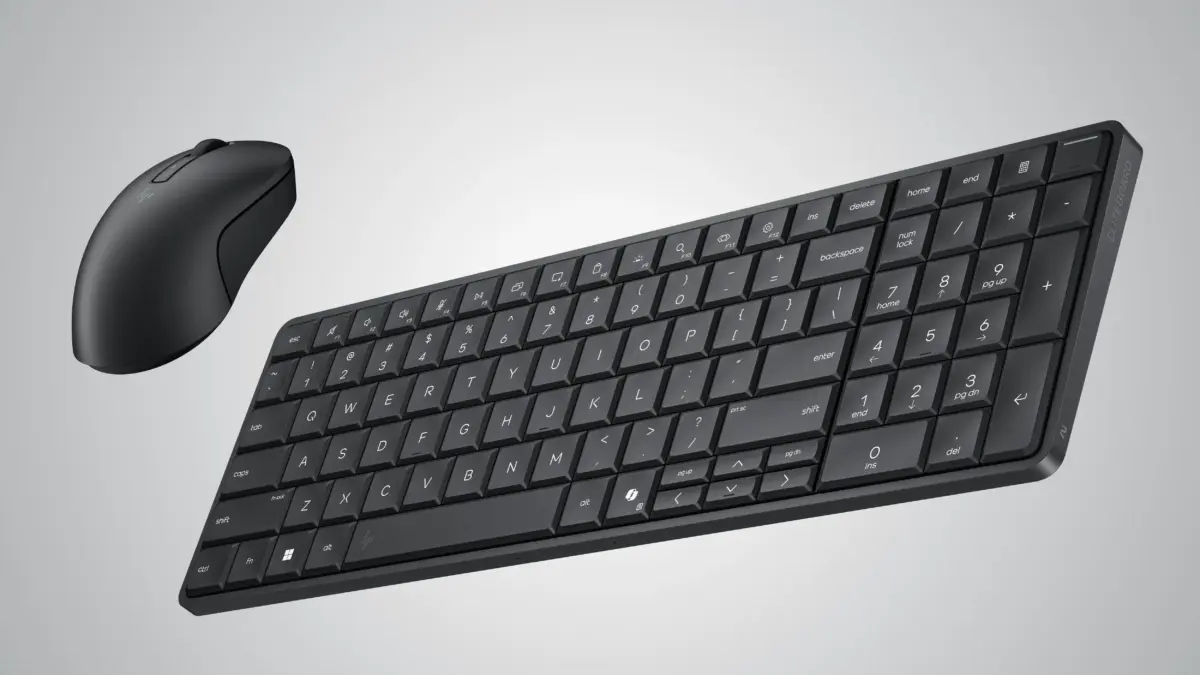
A keyboard that is the entire PC
HP is describing the EliteBoard G1a as the first "AI PC built into a keyboard." The entire system measures roughly 12 mm thick and weighs between 1.5 and 1.7 pounds, depending on configuration. From the outside, it resembles a typical enterprise keyboard with chiclet-style keys, a full function row, and a numeric keypad.
This is not a thin client or a Raspberry Pi-style experiment. The EliteBoard G1a runs full Windows and is powered by modern x86 hardware. Configurations support up to 64 GB of RAM and up to 2 TB of storage, making it suitable for everyday productivity workloads, web-based tools, and standard business applications.
HP is not marketing it as a gaming machine, but it is far more capable than previous "computer-in-a-keyboard" designs that relied on low-power ARM or single-board computers.
Built around Ryzen AI and local processing
At the core of the EliteBoard G1a is an AMD Ryzen AI processor with a dedicated NPU capable of more than 50 TOPS. That places it squarely in the Copilot+ PC category, with hardware designed for local AI workloads.
HP pairs this with its own power and thermal management systems, including Auto State Management and Smart Sense. These adjust performance, cooling behavior, and power draw dynamically based on workload. For users who choose the battery-equipped version, this helps balance responsiveness with limited untethered runtime.
The optional battery allows the keyboard PC to be moved between desks or meeting rooms without immediately reconnecting power. HP also offers a non-battery configuration for fixed desks, which keeps weight down and simplifies deployment.
Designed for enterprise environments
The EliteBoard G1a is aimed squarely at business and enterprise customers. That shows up in the feature set. There is a Kensington lock slot, optional fingerprint authentication, and additional security software baked into the platform.
Connectivity is also conservative by design. Display output relies on DisplayPort rather than HDMI, reflecting typical enterprise monitor deployments. The system can drive up to two 4K displays simultaneously, which aligns with modern office workflows.
HP has confirmed that the device will be sold directly through HP.com rather than through retail channels, reinforcing that this is not a mass-market consumer product.
A clean-desk alternative to mini PCs and laptops
The appeal of the EliteBoard G1a is not raw performance. It is simplicity. For users who already work with external monitors, docks, and peripherals, a keyboard PC removes an entire layer of hardware.
There is no tower under the desk and no mini PC mounted behind a monitor. One cable handles power, display output, and data. Dual microphones and built-in speakers are integrated into the keyboard itself, allowing it to function immediately in video calls without extra peripherals.
The form factor also makes hot-desking and shared workspaces easier to manage. IT departments can deploy identical keyboards across desks, with the computer moving with the user rather than staying fixed in place.
Paired with a new IPS Black 4K monitor
Alongside the EliteBoard G1a, HP introduced the Series 7 Pro 4K Monitor as a companion display. It uses IPS Black panel technology with a claimed 2,700:1 contrast ratio, roughly double that of standard IPS displays.
The monitor is factory calibrated and supports user-defined color profiles when paired with external calibration tools. It also includes a 140W Thunderbolt 4 port capable of handling power, display output, and high-speed data over a single cable.
In practical terms, this allows the EliteBoard G1a to connect to the monitor with one cable for both power and video, turning the display into a hub for the entire setup.
Not a new idea, but a modern execution
Keyboards with built-in computers are not new. Early home computers like the Commodore 64 and Apple II placed the system board under the keys. More recently, the Raspberry Pi 400 revived the idea with a Linux-based design.
What makes the EliteBoard G1a different is that it runs modern Windows on current x86 hardware, with enterprise-grade security and support. This is not a nostalgia play or a hobbyist device. It is meant to replace small form factor desktops in controlled environments.
Availability and pricing
HP says the EliteBoard G1a Next Gen AI PC and the Series 7 Pro 4K Monitor are expected to become available on HP.com in March. Pricing has not been announced.
Whether this form factor expands beyond enterprise will depend on adoption. For now, HP is treating it as a targeted solution for organizations that want fewer boxes, cleaner desks, and centralized hardware management.
Thank you for being a Ghacks reader. The post HP Built a Full Windows PC Into a Keyboard Using Ryzen AI Hardware appeared first on gHacks Technology News.






0 Commentaires